
Bram Stoker's Dracula Gameplay
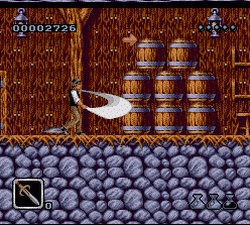
With Bram Stoker's Dracula on SNES, the dark road begins on the very first step, and you instantly feel the game grip your heart: it won’t let you leap on a whim, it pushes you, makes you think half a beat ahead. You don’t sprint through a stage here—you claw through gothic spaces: slick rooftops, chill stone corridors, bats above, treacherous drop-offs at your feet. This horror platformer, based on Coppola’s film, wrings focus out of every jump: a hair early and you tumble, a hair late and you rake into a clawed swipe. All of it under a ticking clock, the timer whispering: “Hurry, Jonathan—the night outlasts us.”
Pace, timing, the level’s breathing
The rhythm here is peculiar: deliberate, but with zero room to wobble. Stages peel open in layers—step, pause, burst, a quick scrap, inhale, move. The timer isn’t UI garnish; it adds that hunter’s pressure, forcing you to plan chains of jumps and strikes ahead of time. You play by ear: the crunch of a crumbling cornice warns you not to linger; the crackle of a torch hints at a platform you can’t quite see. This is platforming discipline in full: a precise run-up, a short duck under a swooping pest, a counter hit—then back into the dark along Dracula’s narrow balconies.
At first the foes feel like noise, but a couple of screens in you start dueling: a bat dives—you meet it with a low cut; a wolf lunges—you step back and run it onto your steel. The controls reward confidence. In Bram Stoker’s Dracula, cool heads get paid: don’t flail, count the beat, guard your seconds. Lose momentum and you’re taxed for it—trip on a tiny mistake, the whole jump chain shatters, and the timer starts ringing in your ears.
Space: from Transylvania to London
Every locale plays by its own rules. A Transylvanian village drowns in fog, low fences hiding traps: rotten planks give underfoot, wells lure with the glint of coins, and cold breath spills from the windows. The castle is another beast: high arches, mechanical plates, spikes underfoot, secret runs behind bookcases. Rooms lit by candelabras carve hard flashes out of the dark, and you catch yourself reading the map by flames. Then London—rooftops in rain, damp tiles, slick ledges where every move demands a clear head. Carfax Abbey is the crescendo: the space itself tightens the screws, long straights let you build speed only to dump you into steps leading into the gloom and heavy doors with bosses behind them.
It’s a joy to hunt for secrets. Something’s off in a wall—strike it, and a niche opens with stashed goodies. Sometimes it’s ammo, sometimes a hefty health bottle, sometimes a short corridor that trims the route. It’s no metroidvania, but the search itch is real: you memorize suspicious bricks, quirks of decor, the hollow note behind the stone. That pays out in more than resources; it gives confidence—you know there’s a fallback when the timer starts to shriek.
Fights, weapons, and the feel of combat
The core tension is all about distance. A knife shines in tight hallways, a sword gives a reliable arc and saves you on stairs, and guns are for when you don’t want to gamble a jump under claws. You ration the pistol, hoard the shotgun for thick-skinned targets—and suddenly realize Bram Stoker’s Dracula teaches composure: don’t panic, don’t spray lead. The trick is how the game makes you weave actions: step—slash—step—shot—crouch—jump. You can almost hear the rhythm’s gears meshing. Even a basic skeleton nudges you into tidy play: miss by half a pixel—eat it, and the timer gets louder again.
Bosses arrive like chapters in the novel. A werewolf bullies with speed and leaps, training you to meet him on the windup. The giant bat is a timing exam: slip along a curve, catch the hang, and carve a chunk of health in one clipped motion. Sometimes you run into an armored brute—slow but devious—who lures you to a wall, and if you lose spacing—there goes a life. The final shapes of the lord of night are a different song, where you dictate the tempo—if you’ve learned the rules along the road. Every victory is less about raw damage and more about a cool head and a dance you drilled.
Traps aren’t box-ticking. Falling tiles teach you to look up; spikes teach you not to leap into the void; moving platforms force quick yet exact decisions. Sometimes a stage squeezes you into a narrow run where you have to duck through a cascade of small pests, and you remember to leave yourself a little pocket of time. In those stretches, Dracula (SNES) shifts from “clear the level” to “survive to the next torch,” every light source a tiny checkpoint for your nerves. And when you finally burst into fresh air, the music changes—and you breathe out with it.
For fans of retro horror and gothic platformers, this delivers exactly what you came for: crisp, exacting jumps, taut duels, that feeling of walking a razor’s edge. Bram Stoker’s Dracula doesn’t chase showy tricks—it’s about discipline, about every movement carrying a cost. And when, at the very end, under organ swells and the wind hissing through empty halls, you take the last step into the final fight, you understand why you endured Transylvania’s fog, London’s rooftops, and the Abbey’s treacherous halls. For that sensation: you crossed the dark and bent it to your rules.